Skip to content

Personalized Hip Assistance to Improve Gait Performance in Individuals with Parkinson’s Disease

Personalized WIM hip assistance, tuned with human-in-the-loop optimization to raise stride length toward healthy norms, improves spatiotemporal and kinematic gait outcomes in people with Parkinson’s disease—and those gains largely persist under dual-task walking.

Seonjeong Kim1 Seungjoo Noh1 Seo Jung Yun2 Jinwoo Hwang3 Yujin Kwon4 Bokman Lim5 Younbaek Lee6 Han Gil Seo2 Keewon Kim2 Jinsoo Kim1

1Seoul National University2Seoul National University Hospital3Carnegie Mellon University4UNC Chapel Hill & NC State University5Korea University of Technology and Education6WIRobotics Inc.

Why this matters

Personalization for heterogeneous PD gait

Inter-individual variability in Parkinsonian gait motivates per-person tuning of assistance magnitude (κ) and timing (β) rather than a one-size-fits-all profile.

Stride length as the optimization target

Human-in-the-loop CMA-ES minimizes the gap between measured and age-/sex-/height-matched healthy stride length, a clinically meaningful hypokinesia marker.

Benefits beyond the assisted joint

Assistance improved cadence, hip ROM, foot-to-floor angle, and whole-body kinematics, with FoG eliminated in one participant and dual-task gains largely preserved.

Personalized hip assistance can increase stride length toward healthy levels and drive whole-body gait improvements that persist under dual-task demands.
Device control and human-in-the-loop optimization

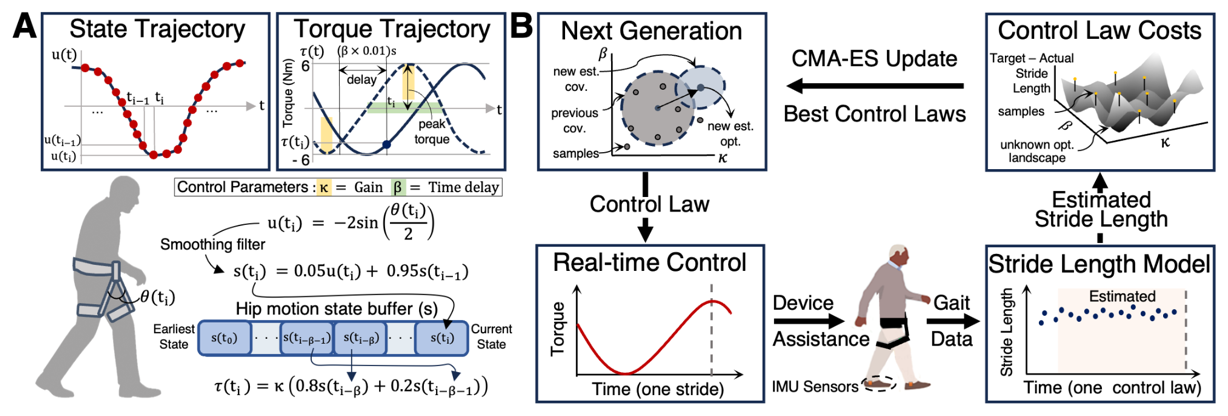
WIM hip assistance control law and CMA-ES human-in-the-loop optimization workflow
Fig. 1. Operating principles of the WIM device and the human-in-the-loop optimization framework. (A) The controller filters the inter-thigh angle into a hip motion state buffer; assistance torque is the state from β samples earlier (β × 0.01 s) scaled by the gain κ, so κ sets the torque magnitude and β its timing. Flexion torque is applied to the swing leg and equal extension torque to the stance leg, saturated at 6 Nm; the yellow and green shaded regions mark the allowable bounds of κ and β. (B) Each control law (κ, β) is applied during walking, IMU sensors estimate stride length, and the gap between the measured and an age-, sex-, and height-matched healthy target stride length is the cost. CMA-ES uses these costs to sample the next generation of control laws.

Study protocol

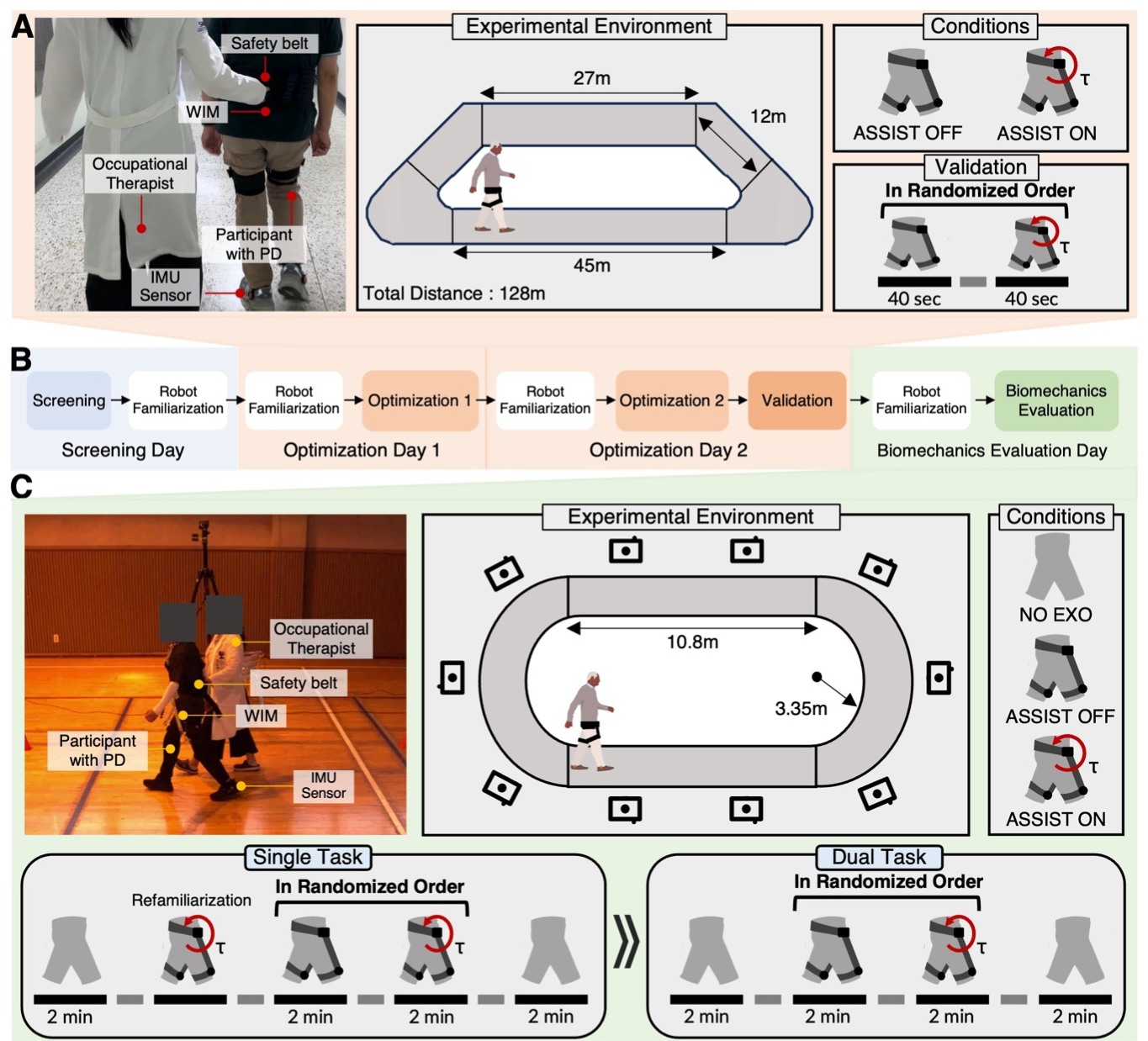
Optimization day corridor setup and biomechanics evaluation protocol
Fig. 2. Study protocol. (A) Optimization Day: participants walked a 128 m hospital corridor loop wearing WIM and an IMU sensor, with an occupational therapist holding a safety belt. Optimization ran over two days, followed by a validation of 40-s ASSIST OFF and ASSIST ON trials in randomized order. (B) Overall timeline: Screening Day, robot familiarization before each session, two Optimization Days, and a Biomechanics Evaluation Day. (C) Biomechanics Evaluation Day: an oval track (10.8 m straights) surrounded by motion capture cameras. Participants completed 2-min trials under NO EXO, ASSIST OFF, and ASSIST ON (randomized order), first as single-task walking and then while performing a cognitive dual task.

Participant-specific assistance

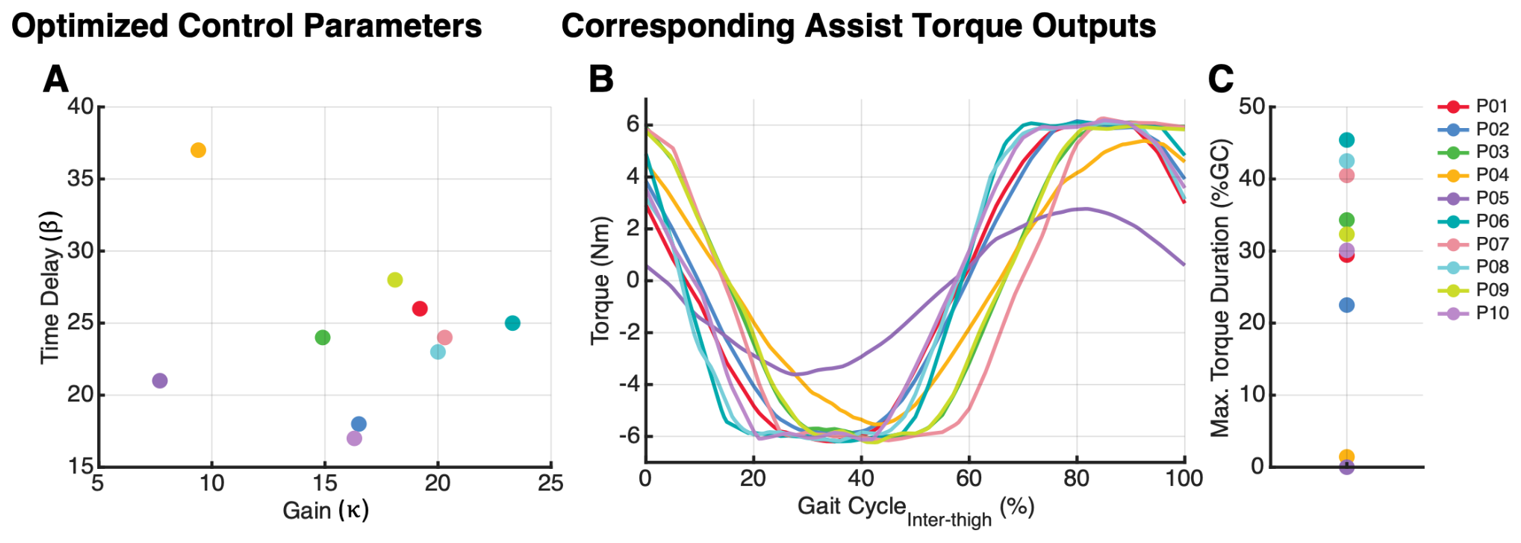
Optimized gain and time delay and resulting torque profiles across participants
Fig. 3. Optimized assistance across the 10 participants. (A) Optimized gain (κ) and time delay (β) converged to different values for each participant. (B) The resulting torque profiles, averaged across strides and aligned to the peak inter-thigh angle (0% gait cycle), differ in shape, peak magnitude, and timing. Positive torque is hip flexion assistance to the left leg and extension to the right. (C) Share of the gait cycle spent at the 6 Nm torque limit, which ranged from near 0% (P04, P05) to about 45%. Together, these show why one fixed assistance profile is a poor fit for heterogeneous Parkinsonian gait.

Gait metrics after optimization

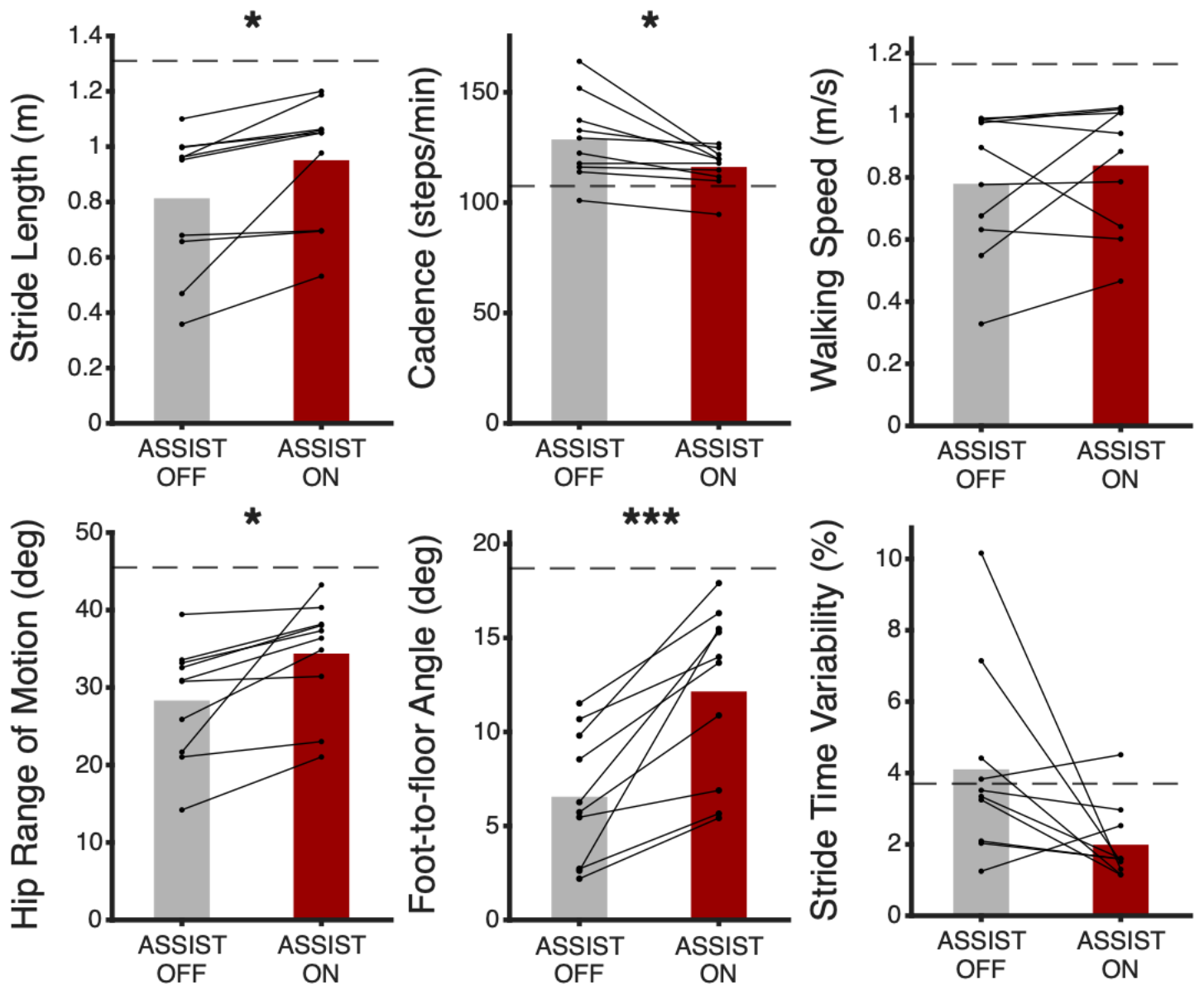
Bar plots of stride length, cadence, hip ROM, and related gait metrics with and without assistance
Fig. 4. IMU-based gait metrics on Optimization Day (n = 10, 40-s trials). Bars show group means, lines show individual participants, and dashed lines show healthy-adult reference values from the literature. With ASSIST ON versus ASSIST OFF, stride length increased by 23.0 ± 32.9% (p < 0.05), with gains in every participant. Cadence fell from 128 to 116 steps/min, approaching the healthy value of 107 (p < 0.05). Hip range of motion rose from 28.3° to 34.4° (p < 0.05), foot-to-floor angle nearly doubled from 6.6° to 12.2° (p < 0.001), indicating a shift toward heel strike, and stride time variability fell from 4.1% to 2.0%. Walking speed did not change significantly. * p < 0.05, *** p < 0.001.

Freezing of gait and dual-task walking

FoG case (P05)

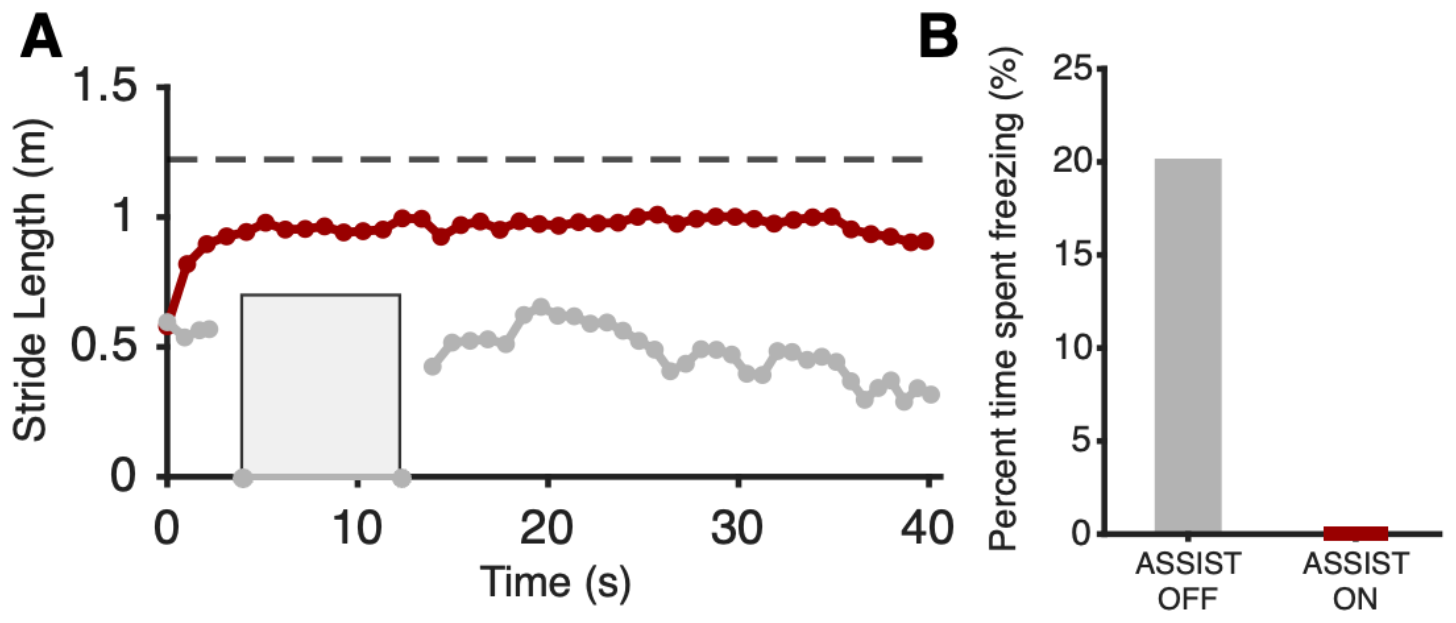
Stride length time series and freezing percentage with assistance on versus off
Fig. 5. Freezing of gait in participant P05. (A) Stride length over a 40-s trial: with ASSIST ON (red), stride length stayed near 1 m throughout. With ASSIST OFF (gray), it was shorter and dropped to zero during a freezing episode (shaded box). The dashed line is the matched healthy stride length. (B) Time spent freezing fell from 20% with ASSIST OFF to 0% with ASSIST ON.

Dual-task

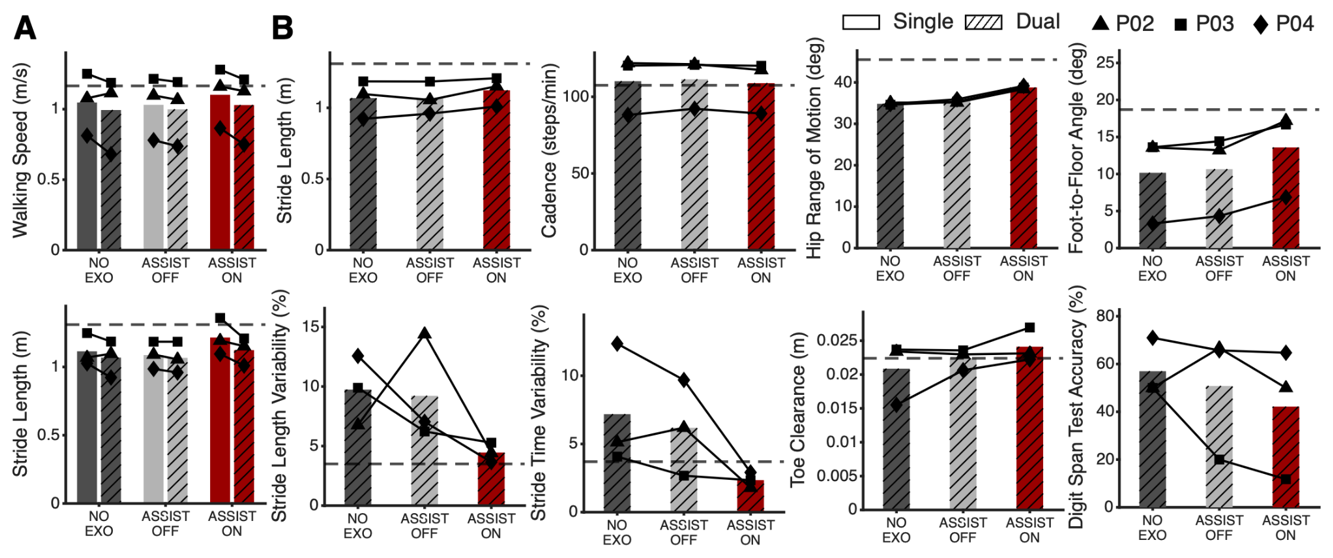
Gait metrics under single-task and dual-task conditions with and without assistance
Fig. 7. Single- versus dual-task walking (n = 3: P02–P04; hatched bars are dual task). (A) The added cognitive task generally reduced walking speed and stride length, confirming higher task demand. (B) Under dual-task walking, ASSIST ON still produced the longest strides, larger hip range of motion and foot-to-floor angle, and lower stride length and stride time variability than NO EXO and ASSIST OFF. Digit span accuracy decreased with ASSIST ON in all three participants.

Whole-body kinematics

Hip knee ankle kinematics and additional gait parameters under three assistance conditions
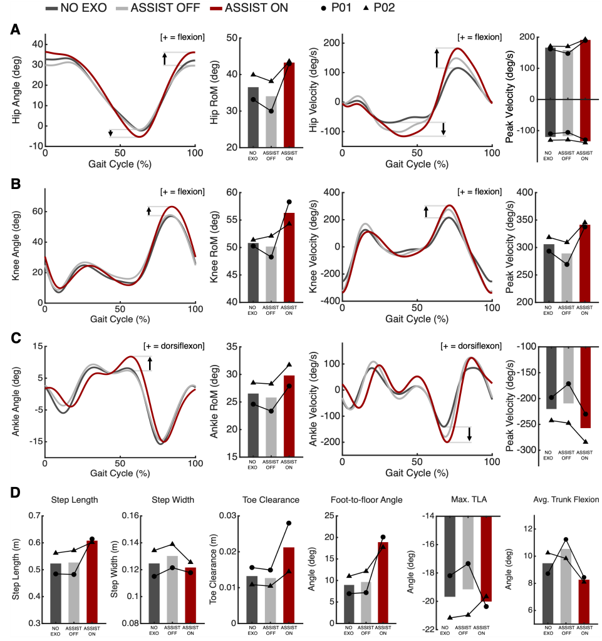
Fig. 6. Motion-capture kinematics on the Biomechanics Evaluation Day (n = 2: P01, P02) under NO EXO, ASSIST OFF, and ASSIST ON. Curves are averaged across strides, sides, and participants, with 0% of the gait cycle at heel strike. Panels A–C show the angle profile, range of motion, angular velocity profile, and peak velocity for each joint; arrows mark changes with assistance. (A) Hip: range of motion increased, along with peak extension velocity in loading response and peak flexion velocity in pre-swing. (B) Knee: range of motion and swing-phase peak flexion velocity increased. (C) Ankle: range of motion and push-off peak plantarflexion velocity increased. (D) Step length, toe clearance, and foot-to-floor angle increased and average trunk flexion decreased (a more upright posture). Step width and maximum trailing limb angle showed no consistent trend. Gains extend beyond the assisted hip joint.

Takeaways

Parkinson’s disease commonly causes gait impairments such as reduced stride length, shuffling, festination, stooped posture, and freezing of gait. To address the limited effectiveness of conventional interventions, this study tested whether personalized hip assistance from a wearable robot could improve gait in individuals with PD. Using human-in-the-loop optimization for 10 participants, personalized assistance increased stride length by 23%, improved cadence, stride-time variability, hip ROM, and foot-to-floor angle, reduced freezing in one participant, and largely preserved benefits under dual-task walking.

Main results

+23% stride length (ASSIST ON vs OFF; p < 0.05, d = 0.95)
10 participants with PD completing optimization (mH&Y 2.5–4)
0% FoG time under ASSIST ON in the participant who froze 20% of the time off
5.4 mean usability rating (7-point scale; n = 10)

Citation

BibTeX

@misc{kim2026personalized,
  title={Personalized Hip Assistance to Improve Gait Performance in Individuals with Parkinson's Disease},
  author={Kim, Seonjeong and Noh, Seungjoo and Yun, Seo Jung and Hwang, Jinwoo and Kwon, Yujin and Lim, Bokman and Lee, Younbaek and Seo, Han Gil and Kim, Keewon and Kim, Jinsoo},
  publisher={Research Square},
  year={2026},
  month={aug},
  doi={10.21203/rs.3.rs-10612204/v1},
  url={https://doi.org/10.21203/rs.3.rs-10612204/v1},
  note={Preprint}
}