Existing defenses leak
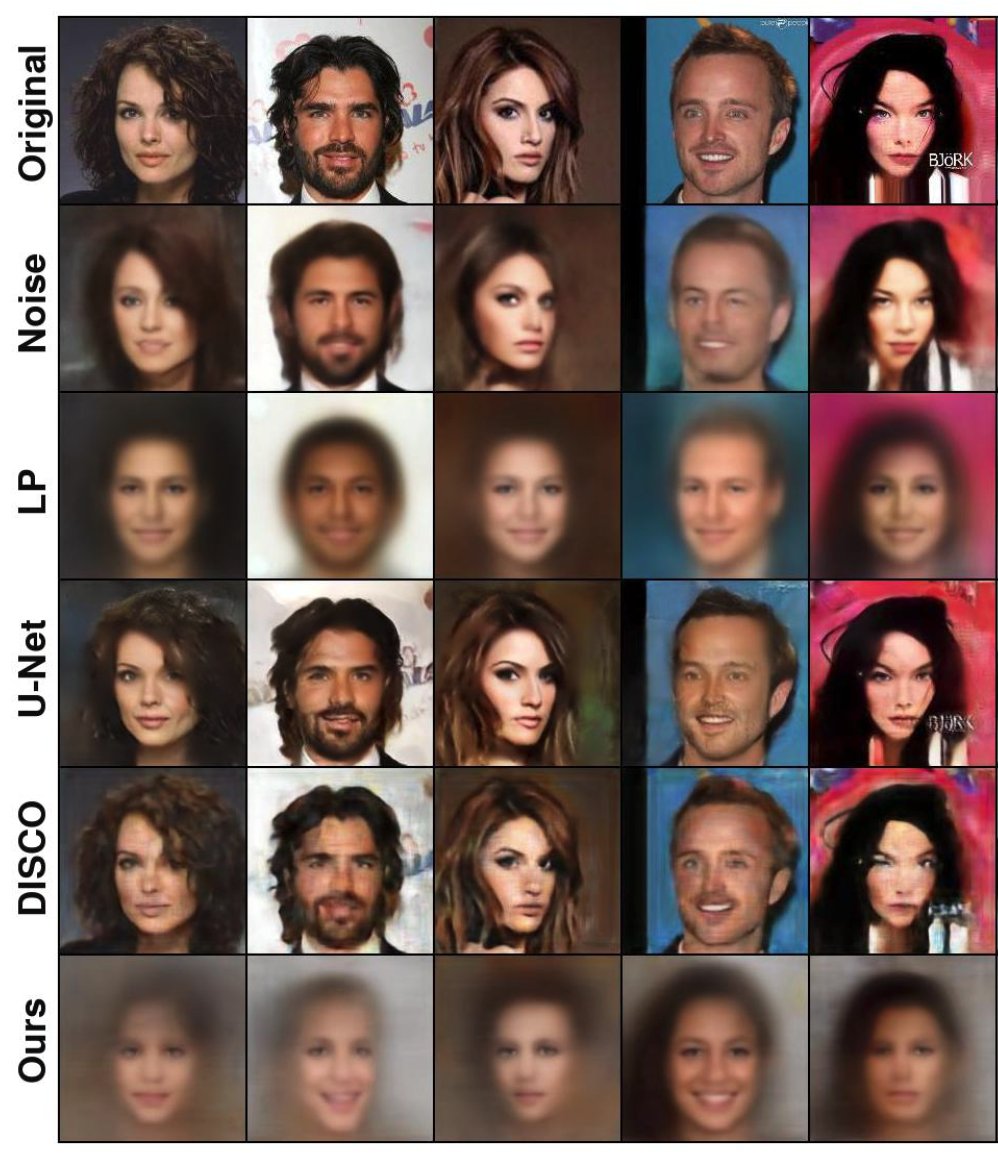
A trained reconstruction attacker can recover the original image from obfuscations produced by existing adversarial representation learning (ARL) methods.
IJCAI-ECAI Workshop on Artificial Intelligence Safety (AISafety) 2022
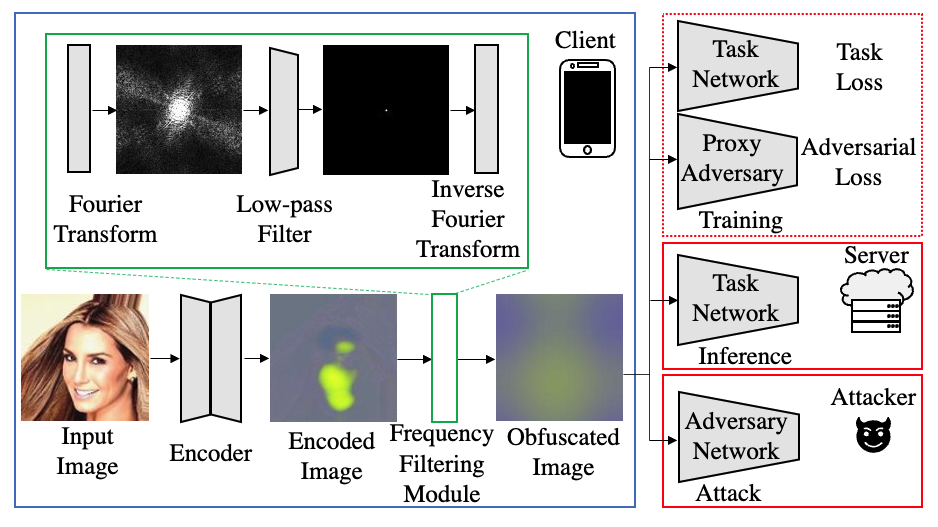
A low-pass frequency filtering module in the client-side encoder limits what a reconstruction attacker can recover, strengthening privacy while preserving task utility.
1Deeping Source Inc.
A trained reconstruction attacker can recover the original image from obfuscations produced by existing adversarial representation learning (ARL) methods.
A low-pass filtering module restricts the information the encoder can carry in the frequency domain, reducing what an attacker can reconstruct.
The method withstands reconstruction attacks while outperforming prior state-of-the-art methods on the privacy-utility trade-off.
Low-pass filtering narrows the information available to a reconstruction attacker while preserving useful task representations.
Deep learning models are increasingly deployed in real-world applications. These models are often deployed on the server-side and receive user data in an information-rich representation to solve a specific task, such as image classification. Since images can contain sensitive information, which users might not be willing to share, privacy protection becomes increasingly important. Adversarial Representation Learning (ARL) is a common approach to train an encoder that runs on the client-side and obfuscates an image. It is assumed, that the obfuscated image can safely be transmitted and used for the task on the server without privacy concerns. However, in this work, we find that training a reconstruction attacker can successfully recover the original image of existing ARL methods. To this end, we introduce a novel ARL method enhanced through low-pass filtering, limiting the available information amount to be encoded in the frequency domain. Our experimental results reveal that our approach withstands reconstruction attacks while outperforming previous state-of-the-art methods regarding the privacy-utility trade-off. We further conduct a user study to qualitatively assess our defense of the reconstruction attack.
Citation
@article{jeong2022privacy,
  title={Privacy Safe Representation Learning via Frequency Filtering Encoder},
  author={Jeong, Jonghu and Cho, Minyong and Benz, Philipp and Hwang, Jinwoo and Kim, Jeewook and Lee, Seungkwan and Kim, Tae-hoon},
  journal={arXiv preprint arXiv:2208.02482},
  year={2022},
  note={IJCAI-ECAI Workshop on Artificial Intelligence Safety (AISafety)}
}