Better multiview aggregation
Homography-based attention improves how features from calibrated camera views are fused into a bird’s-eye-view occupancy map.
IEEE/CVF Winter Conference on Applications of Computer Vision (WACV) 2024
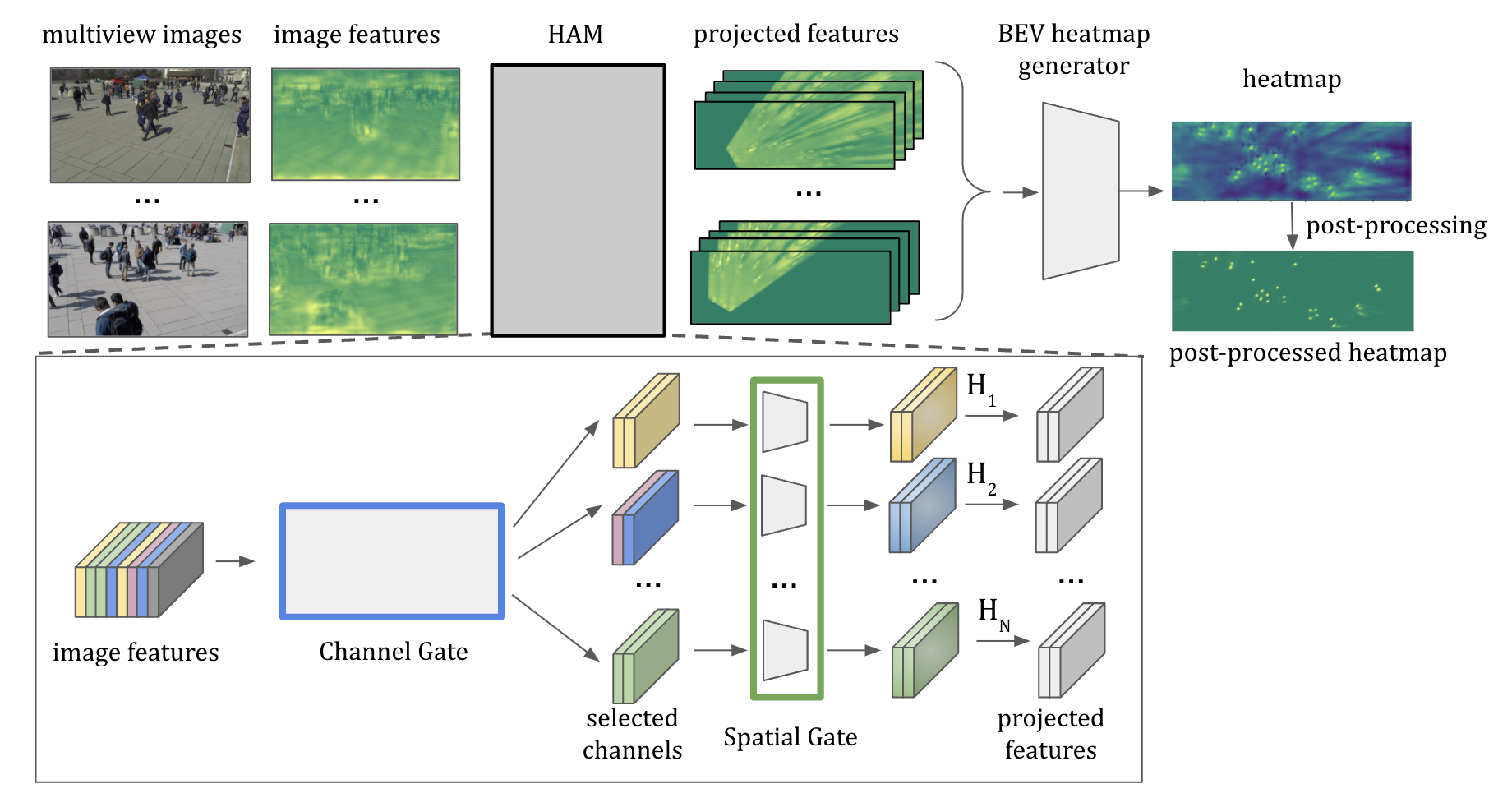
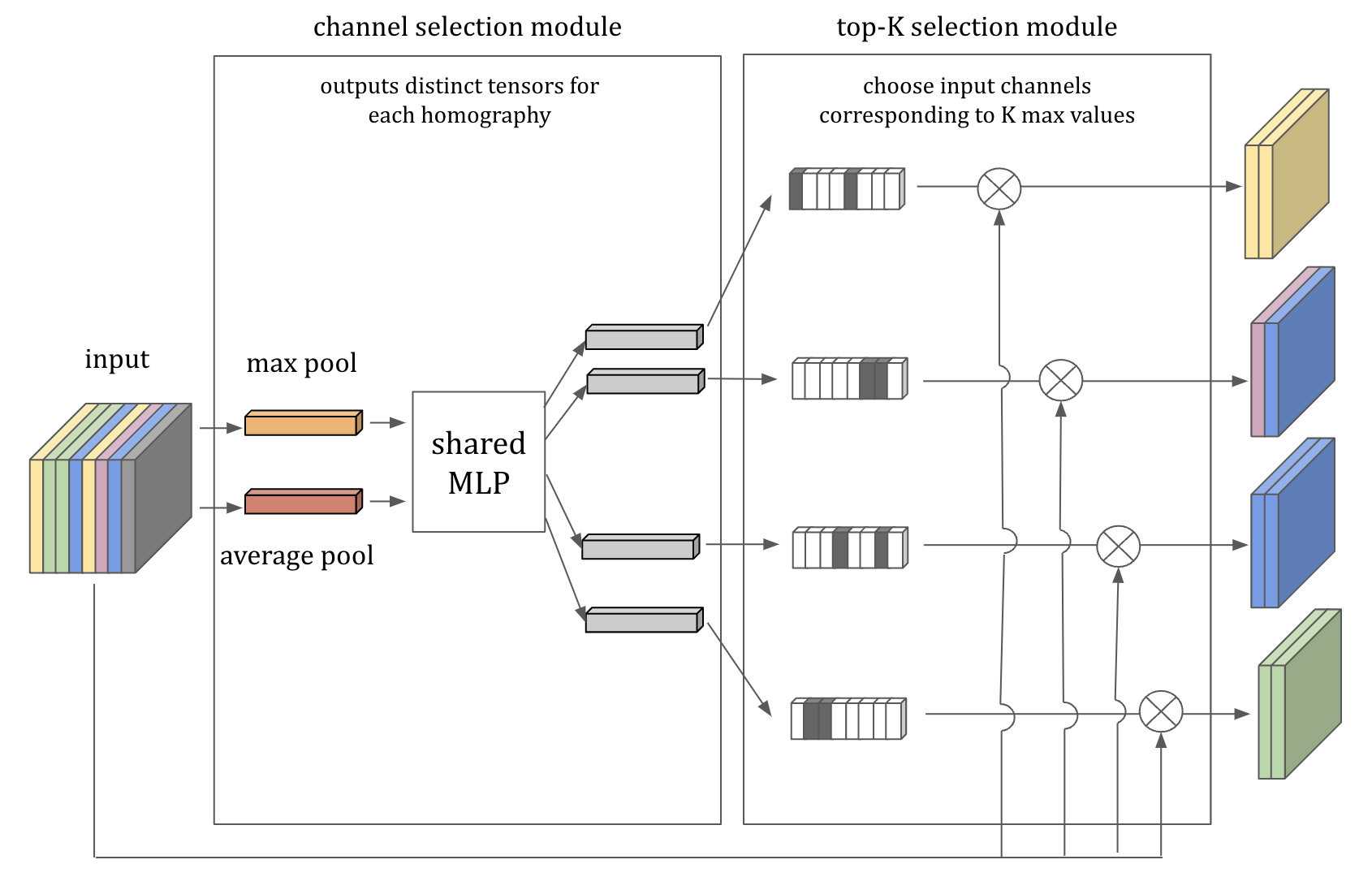
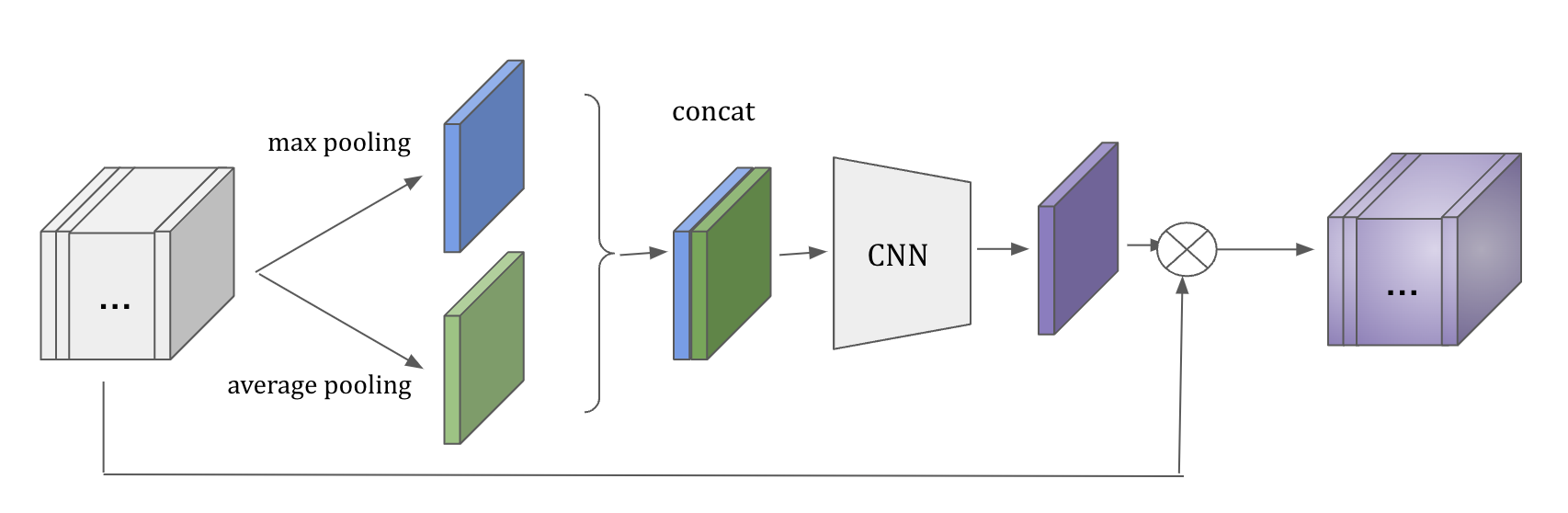
A Homography Attention Module selects channels and spatial regions per homography plane, boosting end-to-end multiview pedestrian detection to state-of-the-art MODA on Wildtrack and MultiviewX.
*Work performed while Jinwoo Hwang was at Deeping Source Inc.
1Seoul National University2Deeping Source Inc.
Homography-based attention improves how features from calibrated camera views are fused into a bird’s-eye-view occupancy map.
HAM’s channel gate and spatial gate drop into existing end-to-end detectors (MVDet, SHOT, MVDeTr) and improve their performance.
Booster-SHOT combines HAM with stacked homography transformations and view-coherent augmentation to reach state-of-the-art MODA.
Attention-guided homography fusion improves multiview pedestrian detection and bird’s-eye-view occupancy mapping.
Improving multi-view aggregation is integral for multiview pedestrian detection, which aims to obtain a bird’s-eye-view pedestrian occupancy map from images captured through a set of calibrated cameras. Inspired by the success of attention modules for deep neural networks, we first propose a Homography Attention Module (HAM) which is shown to boost the performance of existing end-to-end multiview detection approaches by utilizing a novel channel gate and spatial gate. Additionally, we propose Booster-SHOT, an end-to-end convolutional approach to multiview pedestrian detection incorporating our proposed HAM as well as elements from previous approaches such as view-coherent augmentation or stacked homography transformations. Booster-SHOT achieves 92.9% and 94.2% for MODA on Wildtrack and MultiviewX respectively, outperforming the state-of-the-art by 1.4% on Wildtrack and 0.5% on MultiviewX, achieving state-of-the-art performance overall for standard evaluation metrics used in multi-view pedestrian detection.
Citation
@inproceedings{hwang2024boostershot,
  title={Booster-SHOT: Boosting Stacked Homography Transformations for Multiview Pedestrian Detection with Attention},
  author={Hwang, Jinwoo and Benz, Philipp and Kim, Pete},
  booktitle={Proceedings of the IEEE/CVF Winter Conference on Applications of Computer Vision (WACV)},
  year={2024},
  pages={362--371},
  doi={10.1109/WACV57701.2024.00043}
}